
Piotr Serafiński, Manager of Family Office Service Development, PKO BP | 26 czerwca 2026
Every day, the world gains an average of 89 individuals with wealth exceeding USD 30 million. Over the past five years this group has grown exceptionally fast, and Poland is among the countries where it has grown fastest of all. This is one of the central conclusions of the twentieth anniversary edition of the Knight Frank report “The Wealth Report,” which has for years served as an important point of reference for those who work with affluent clients.
Poland in the Global Rankings
The scale of the global increase in wealth is striking. According to the Knight Frank model, the number of individuals worth more than USD 30 million rose worldwide from 551,435 in 2021 to 713,626 in 2026 – an increase of more than 160,000 people in five years.
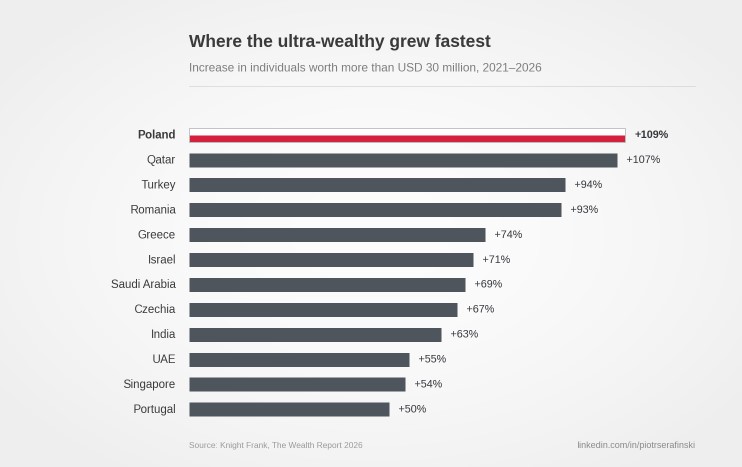
Against this backdrop, Poland stands out for its pace. Over the same period, the number of individuals worth more than USD 30 million in Poland rose from 1,442 to 3,017, more than doubling. According to the report, this is the highest growth rate among all the countries it covers; Poland outpaced Qatar and Turkey, among others.
Growth in the number of individuals worth more than USD 30 million, 2021–2026.
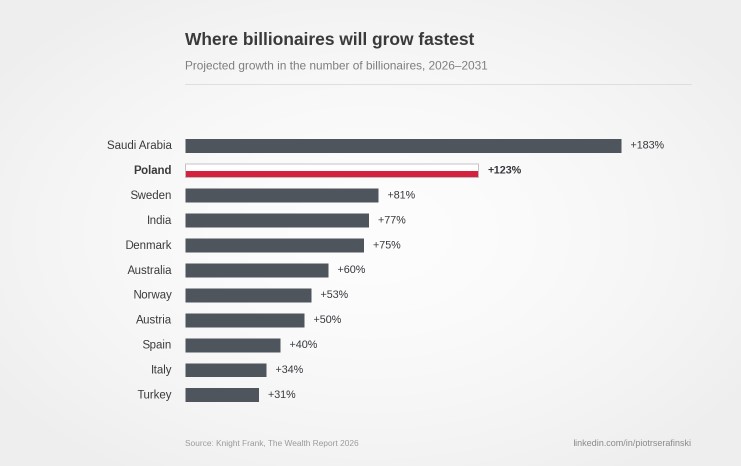
A similar picture emerges from the forecasts. The number of billionaires in Poland is projected to rise from 13 to 29 by 2031, an increase of 123 percent. Only Saudi Arabia is expected to add them faster.
Projected growth in the number of billionaires, 2026–2031.
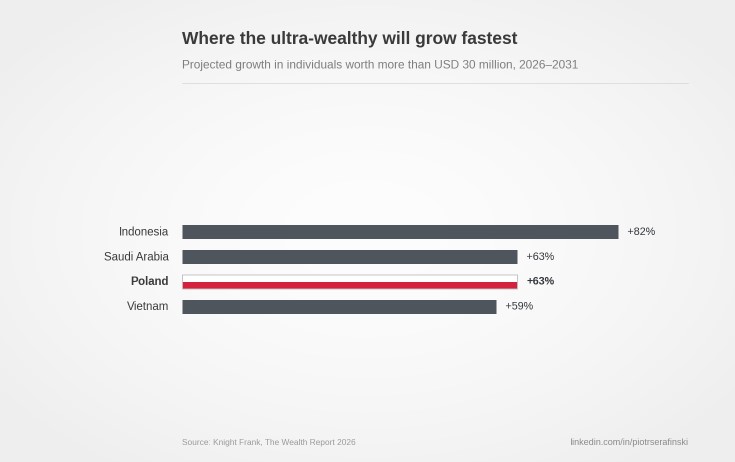
Within the broader group of individuals worth more than USD 30 million, the forecast assumes growth of 63 percent for Poland, to nearly 4,900 people by 2031, which again places the country among the global leaders, alongside Indonesia and Saudi Arabia.
Projected growth in the number of individuals worth more than USD 30 million, 2026–2031.
Where This Wealth Comes From
The numbers alone, however, do not tell the whole story. Where this wealth came from matters as much as how fast it has grown.
In many fast-growing countries, the increase in large fortunes rests largely on state programs and commodity revenues. Polish capital has a different lineage. It was built up gradually over the past three decades, most often from scratch, by entrepreneurs, engineers and investors – people who started out at the beginning of the economic transition and today run companies with international reach. Wealth built this way tends to be more durable and less sensitive to individual swings in the business cycle, because it depends neither on a single political decision nor on a single commodity cycle.
It is worth keeping a sense of proportion here. The United States remains the main center of the global increase in wealth, accounting for 41 percent of all new fortunes of this size. Poland remains a far smaller market, but in terms of growth rate alone it stands out remarkably in this comparison.
Where Private Capital Is Investing
The report also says a great deal about where this capital is flowing. Three areas are particularly relevant for the Polish market.
Premium real estate attracts the most attention. Prices of luxury apartments and houses across the world’s hundred most important markets rose by an average of 3.2 percent in 2025, for the second year running faster than the residential market as a whole. Behind this average, however, lie enormous differences: in Tokyo prices climbed by 58.5 percent, in Dubai by more than 25 percent. Demand for move-in-ready properties is becoming increasingly pronounced. In 2026, 22 percent of the wealthiest individuals plan to purchase a luxury property.
Less obvious, but equally important, is the shift in the commercial real estate market. For the fifth year in a row, the largest buyer worldwide is private capital – wealthy individuals and family offices. In 2025 they invested USD 464 billion in this segment, compared with USD 347 billion of institutional capital. The wealthiest investors are increasingly setting the direction of this market rather than merely following it.
Passion assets form a category of their own. After a period of correction, the Knight Frank Luxury Investment Index has stabilized, closing 2025 with a slight decline of 0.4 percent. Impressionist art and watches performed best, and alongside the classic categories new forms of investing are emerging, among them fractional-ownership platforms, which are opening the collectors’ market to younger investors.
What This Means for the Family Office Market in Poland
The twentieth edition of the report returns to the idea with which Knight Frank began in 2007: so-called plutonomy. The notion is that in certain economies it is the wealthiest who, through their spending and investment, increasingly drive the market. The data of recent years bear this thesis out.
Liam Bailey, who leads the report, points out that what matters most today is not so much the growth of wealth itself as its protection and thoughtful deployment. From the perspective of the Polish market, this observation appears apt.
A growing group of affluent clients means greater demand for real estate, premium assets and more sophisticated wealth management services.
Serving this group of clients extends far beyond a single investment product. It also encompasses wealth structuring – including through a family foundation (fundacja rodzinna) – property management and ensuring the continuity of wealth across generations, the areas in which a family office operates. Its importance in the Polish market will grow along with this client group.
The Knight Frank data illustrate well the scale of change in Poland’s affluent client segment. The extent to which the financial market responds to it will be decided in the years ahead.
Data: Knight Frank, The Wealth Report 2026.
Contact do author: https://www.linkedin.com/in/piotrserafinski/